

Accredited VA Claims Agent
Call: 702-992-4883


Forensic Intelligence for the VA Claims System
The word "forensic" is not decorative. It means your file will be examined the same way evidence is examined in a legal proceeding — methodically, sourced, and with a specific outcome in mind. The VA claims system generates thousands of pages of records, decisions, exam reports, and legal determinations over the course of a veteran's claim history. Most of that material is never fully reviewed, never cross-referenced, and never organized in a way that surfaces what it actually contains. A tactical deconstruction of your file changes that. Every document becomes a data point. Every decision becomes a trail. Every gap becomes an opportunity — if you know where to look and what you are looking for.

You Did Everything Right. The System Still Stalled.
Attending exams, seeking regular care, securing a diagnosis, submitting records, gathering buddy letters — these are the actions of a veteran doing everything by the book. A denial after all of that is not a reflection of your service, your injuries, or your credibility. It is a reflection of a system that processes volume, not merit. Denials, deferrals, zero percent ratings, and years of stagnation at the same rating are not final answers — they are administrative outputs from a machine that never fully saw your file. The absence of an explanation is not evidence that one does not exist. It means no one has gone looking for it yet.

The VA Relies on Exhaustion and Opacity
Backlogs are not accidents — they are the operating condition of a system that was never resourced to handle the volume of claims it receives. Raters work under time pressure. Examiners are not required to review your full claims file before rendering an opinion. Decisions are issued without detailed explanations of what evidence was weighed and what was set aside. The result is a system that is structurally difficult to challenge because it does not show its work. Veterans who do not understand what is inside their own file cannot identify where the process broke down — and that is exactly the condition the system depends on to remain unchallenged.

The Anatomy of a Mission 5 Intelligence Brief
Seven components. One integrated analysis. The military and medical timeline establishes the chronological foundation. The claims timeline maps every decision ever made on your file. The C&P and DBQ review autopsies every examiner report against your actual evidence. The evidence gap analysis identifies exactly where your file breaks down. The identification of favorable evidence surfaces what is already working in your favor. The law and rules application documents every instance where the VA failed to follow its own legal framework. The prioritized action plan translates all of it into a specific, sequenced set of next steps. Each layer informs the next. Nothing in this document is isolated.

Reconstructing the Timeline to Make Connections Visible
From entrance exam baseline through obscure service treatment records, exit physical, every VA decision, and present-day diagnosis — every documented medical event is mapped in sequence. The chronology does something no individual document in your file can do on its own: it reveals the pattern. It shows where the nexus was established, where it was lost, and where the VA failed to connect documented in-service events to a current condition. Nexus is not always missing — it is often present in the record and simply never organized in a way that made the connection visible to a rater working under time pressure.

Most Veterans Are Told What They Lack. We Show You What You Already Have.
Favorable evidence is already inside most veterans' files. It was submitted, scanned, and filed — and then never organized in a way that made its significance clear to the rater who issued the decision. A service treatment record entry that establishes an in-service event. A VA treatment note that documents a symptom pattern consistent with a higher rating. A prior C&P exam that contains language supporting service connection that was never cited in the decision. Extracting and organizing this evidence does not require new records in many cases. It requires a thorough review of what is already there and a clear presentation of what it means.

Enforcing the VA's Own Legal Frameworks
Correct rating schedule application, accurate effective dates, benefit of the doubt standard, PACT Act and TERA toxic exposure eligibility, Agent Orange presumptives — these are not optional considerations. They are legal requirements. When the VA fails to apply the correct diagnostic code, veterans receive lower ratings than the law entitles them to. When effective dates are set incorrectly, veterans lose back pay they are legally owed. When the benefit of the doubt standard is not applied, claims are denied on evidence that should have produced a grant. Every one of these failures is documented, citable, and challengeable — with specific CFR provisions, case law from the Court of Appeals for Veterans Claims, and M21-1 manual references.
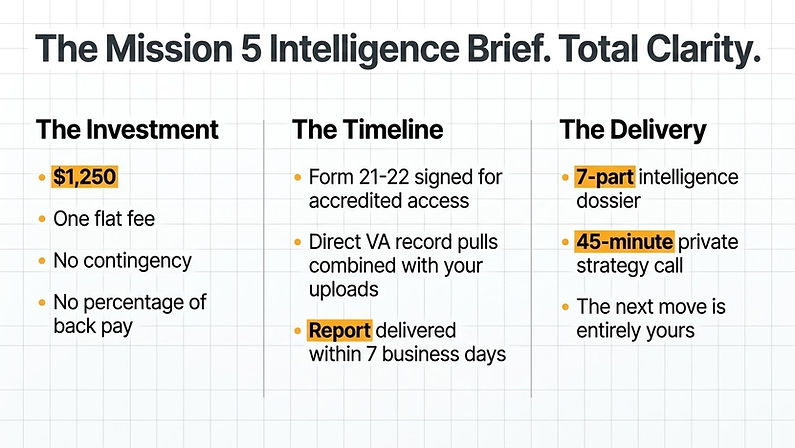
The Mission 5 Intelligence Brief. Total Clarity.
One flat fee. No contingency. No percentage of back pay. VA Form 21-22 signed for accredited access, direct record pulls combined with your uploads, report delivered within seven business days. A seven-part intelligence dossier and a 45-minute private strategy call. After that call, the intelligence is yours — to use however you choose, with whoever you choose, on whatever timeline you choose. There is no lock-in, no obligation, and no dependency on VADA for anything that follows. The brief is the foundation. The strategy call is the translation. What you build on it from that point forward is entirely in your hands.
